.

Rabu, 04 Mei 2016

A THESIS ABOUT MORPHOLOGY

What ?  A thesis? About what? Hehe...
I found a thesis in my library at My University, so many thesis we could find there... :)
Why I am interested to find thesis? What is special? Hehe..
So, I went to library to found thesis that is connecting with our study “an introduction to linguistics”
Finally, i am excited to post in my blog... hehe...
Are you curious? Okee this is it...:)


alright guys, it is a thesis that i choose, because the content coherent with morphome especially preffix and suffixes (awalan dan akhiran).


so, how about prefixes and suffixes in minangnese language of painan dialect ?
you know guys Painan? it is a part of west sumatera , one of popular place  in there is Carocok Beach, it is a beautiful place to vacation...hehe...

so , what is the formulation of the research?


and then this is prefixes and suffixes:


Last,  the conclusion of the research :


well, guys it is that all I share to you, I hope it is be useful for you... and be inspiration if you want to write a thesis... oke see you guys :)

Selasa, 03 Mei 2016

ABOUT LEXICOLOGY

Assalamualaikum wr.wb good time everyone .. so let we study about the lexicology in this oppurtunity... have fun 

Definition Of Lexicology
Lexicology adalah ilmu/studi mengenai bentuk, sejarah dan arti kata-kata.
menurut bahasa lexicology berasal dari kata lexicon yang berarti: kamus, mu'jam atau istilah dari sebuah ilmu.
Menurut istilah, leksikologi adalah ilmu pengetahuan yang mempelajari seluk beluk makna/arti kosakata yang telah termuat atau akan dimuat di dalam kamus.
Lexicology studies word formation,semasiology, etymological characteristicsof words, phraseological units,lexicography and so on
General and Special Lexicology
The general study of words and vocabulary, irrespective of the spe­cific features of any particular language, is known as general lexicology. .
Special lexiсоlоgу devotes its attention to the des­cription of the characteristic peculiarities in the vocabulary of a given language.
Lexicology deals with the vocabulary and characteristic features of words and word-groups ;

  • Ø  The term “vocabulary” is used to denote the system of
  • words and word-groups that the language possesses.
  • Ø  The term “word” denotes the main lexical unit of a
  • language resulting from the association of a group ofsounds with a meaning.
  • Ø  The term ‘word group” denotes a group of words
  • which exists in the language as a ready-made unit, has
  • the unity of meaning, the unity of syntactical function.

According to the theorotical basis of the vocabularies of different languages there are three types of them:
1.      Historical lexicology
 deals with the historic change of words in the course of language development.
2.      Descriptive lexicology
deals with the vocabulary of a given language at a period of time.
3.      Contrastive lexicology
 studies languages from the point of view of their identity and differentation.

Word-Formation and Word-Classes in Lexicology

Word formation these can be summarised as follows:
Suffixation: man+ly = manly
Preffixation : un+true = untrue
Affixation : dis+taste+ful =distasteful

Prefixes
We add prefixes before the base or stem of a word.
Examples
prefixes
monorailmonolingual
mono- means ‘one’
multipurposemulticultural
multi- means ‘many’
post-warpostgraduate
post- means ‘after’
unusualundemocratic
un- means ‘not’ or ‘opposite to’
See also:

Suffixes
We add suffixes after the base or stem of a word. The main purpose of a suffix is to show what class of word it is (e.g. noun or adjective).


Examples
suffixes
terrorismsexism
-ism and -dom are used to form nouns
employeractor
-er and -or are used to form nouns to describe people who do things
widen, simplify
-en and -ify are used to form verbs
reasonable,unprofitable
-able is used to form adjectives
unhappily,naturally
-ly is a common suffix used to form adverbs

Typical word-class suffixes
A suffix can often, but not always, tell us if a word is a noun, verb, adjective or adverb:
nouns
Verbs
adjectives
Adverbs
station
government
cruelty
soften
identify
industrialise
drinkable
Japanese
useless
carefully
easily
sadly


The importance of English lexicology is based not on the size of its vocabulary, however big it is, but on the fact that at present it is the world’s most widely used language.
So, lexicology as a branch of linguistics has its own aims and methods of scientific research, its basic task being the study and systematic description of the vocabulary of some particular language in respect to its origin, development and current use. Hence lexicology investigates words, word-groups, word-equivalents and morphemes which make up words.

REFERENCE

An Introduction to Linguistics , Loretto Todd

Senin, 02 Mei 2016

STRUCTURE : PAST PERFECT

Pengertian Past Perfect Tense
Past perfect tense menerangkan tentang suatu kejadian dimasa lampau yang telah selesai saat itu juga, sebelum kejadian masa lampau lainnya terjadi.

Rumus Past Perfect Tense:
(+) S + Had + V3 
(-)  S + Had + Not + V3
(?) Had + S + V3

Example :
(+)She had gone to Amsterdam 

(-)She had not gone to Amsterdam 

(?)Had she gone to Amsterdam ?

explanation about past perfect:


well guys, after you understand about past perfect tense, please check this website to do exercise, it will be fun :D


EXERCISE:

I.                   Use the simple past or past perfect to complete the sentence.

1.      Sam (be) ....... a newspaper reporter before he (become) ..... a businessman.
Answer: had been, became

2.      I (see,never)...... any of picasso painting before I (visit)..... the art museum.
Answer: had never seen, visitted

II.                 Complete the sentence with your own word.
1.      My..... after I had already....
Answer: my brother had gone to school after I had already to ate.

2.      When I....., someone else had already...
Answer: When I got finished my work, someone else had alrady eaten.


REFERENCES

English Grammar Third Edition, Betty Schrampfer Azar

Selasa, 26 April 2016

SYNTAX

Definition of syntax
in linguisticssyntax refers to the rules that govern the ways in which words combine to form phrasesclauses, and sentences.
  1. Box
  2. That big box
  3. That big box are very heavy
(1) is word. Then, (2) is phrase and the last, (3) is Clause
The phrase made up of a few words and then will grow larger into a clause.

you know syntax have tree, to make a sentence, please check this video:


1. Phrase
Phrase is a group of two or more grammatical linked words that do not have subject and predicate 
Phrase devided into:

A. Noun phrase
Example:
Are you waiting someone special?
The young man threw the old dog a bone.
That rich man will build his eldest daughter a fine house

B. Adjective phrase
Example:
Never have I been angry with you. (tak pernah saya marah denganmu)
The child, laughing happily ran out of the house (anak-anak, tertawa bahagia berlari keluar rumah)


C. Verb phrase
Ex:
She has been singing (dia telah sedang menyanyi)
He may be following us (dia boleh mengikuti kita)

D. Adverb phrase
Adverb phrase merupakan frasa yang terdiri dari adverb dengan qualifier (c/ too, very, so)
Example:
She almost always arrives on time (Dia hampir selalu tiba tepat waktu)
He ran very quickly (dia berlari dengan cepat)

E. Prepositional phrase
 merupakan gabungan antara preposition dengan object dan berfungsi sebagai adverb.
Example :
There is distance between you and me.(Ada jarak antara kamu dan aku.)
Students arrived at school.
Do you know that man with the scar? (kamu tahu pria dengan bekas luka itu)

2. Clause
When my mother came, I was watching television with my brother and his friend
Main clause                             dependent clause

There are 3 types:
Adjective clause is a dependent clause that explain noun/pronoun
The man which won the competition is a doctor
The girl whom we met on holiday is coming to see us next week.

Adverbial clause: Is a dependent clause that classification based on meaning from previous conjugation.
shut the door before you go out
Put it where we can all see it.

Noun clause: functioning like a noun.
What you said was not true
I know where she lives
I don’t understand how all it happened


3. Sentence
A. Simple sentence
she is a beautiful woman
I want to eat something
He wanna be a pilot

B. Compound sentence: it is sentence at least two independent clause (gabungan) and conjuction like: and, but, so, either,or, either, neither,nor,the, yet.
Main clause: 1. john wants go to the beach 2. Her sister wants go to the amusment park
So, can be :
John wants to go to the beach, but her little sister insist to go to amusement park
(Anne ingin pergi ke pantai, tetapi adiknya bersikeras untuk pergi ke taman huburan)

C. Complex sentence: it is sentence with one independent clause
Independent Clause: I like the book.
Dependent Clause: that you bought yesterday.
Complex Sentence: I like the book that you bought  yesterday. 
                                    Pikiran utama              pikiran tambahan
 Another example:
She became queen when her father died because she was the eldest child.

well guys, i have some sites for you , to enlarge our knowladge about syntax:

and this is special for you, please play the game , it is easy guy :D
Syntax/Grammar Game:
Sentence Game:
Phrase and Clause Game :
An Introduction to Linguistics, Loretto Todd


Selasa, 12 April 2016

MORPHOLOGY

Well guys, in this oppurtunity i would like to explain about morphology, this is it:

Morphology is concerned with the study of morphomes, which are the smallest units of grammar.

Let’s see this word:
Singular                        Plural
rabbit                             rabbits
bus                                 buses
house                             houses

in the example, there are two morphomes, it is rabbit and s.

Free and bound morphomes

Mean-ing-less = meaningless
The word are composed by three morphomes.

Dis-like = dislike
The word are composed by two morphomes that is bound.

Bound morphomes divided into two: like “dis-“ and “un-“  and ending “-ly” , “-ness

Next, let’s see this word:
Word                             Pronunciation
Slammed                       /slæmd/
Slipped                          /slıpt/
Stilted                           /stıltıd/

We didn’t saying that word without –ED , we known as “ allomorphs”.
In adjective form:
In-tolerant
Il-legal
Im-possible
So, il-, im-,in-,and ir-, can be called allomorphs

Bound morphome divided into two:
Derivational morphology
Inflectional morphology

We are going to explain about derivational morphology

Morphomes can be used to form new words:
Beauty +ful = beautyful
Un+true = untrue
Sub+consious+ly =subconsiously

But not always change intothe function of the word:
Prefix              free morphomes                      result
Be                   witch(n)                                   bewitch(v)
De                   limit(v)                                    delimit(v)
En                   rich(adj)                                   enrich(v)
Ex                   terminate(v)                             exterminate(v)
Hyper             market(n)                                 hypermarket(n)

Next, the word ending in the morphomes “-acy,-ation, -er, -or, -ess, -ity, -ment, -ness, -ship tend to be noun:
Democracy      painter             bewilderment
Adoration       mistress            weakness

Inflectional morphology
It is do not involve a change of word class.

Plural:
Book               books

Possesive :
Ratna              ratna’s ring

Irregular :
Mouse             mice


REFERENCE

An Introduction to Linguistics book, Loretto Todd

Rabu, 06 April 2016

PHONOLOGY SUMMARY

Phonology adalah cabang ilmu pengetahuan yang menggabungkan suara satu dengan suara dua yang memiliki arti, inilah yang membedakannya dengan Phonetics. Seperti sebelumnya kita telah tahu apa itu phonetics yang hanya mengeluarkan bunyi tanpa tahu apa artinya. Pada kesempatan ini teman-teman saya akan membahas tentang phonology yang mencakup tentang IPA (International Phonetics Alphabet)

There is a link about IPA and there are the pronounciation of word, you should open this link:

http://www.antimoon.com/how/pronunc-soundsipa.htm

http://www.omniglot.com/writing/ipa.htm 

And and that is the table of IPA For youu... 


The IPA can be helpful for studying a language, especially languages that use letters that are silent or have multiple pronunciations. The IPA uses a single symbol to desribe each sound in a language. If a letter in a word is silent, there will be no IPA symbol used in the transcriptions. 

and the place we make it with:

1. Bilabial

(Bibir atas dan bawah bertemu)

/p/ as in "purse" and "rap"

/b/ as in "back" and "cab" 

/m/ as in "mad" and "clam"


2. Labio-Dental
(Gigi atas dan bibir bawah bertemu)

/f/ as in "fro" and "calf"
/v/ as in "vine" and "have"


3. Dental
(lidah dengan bagian depan gigi atas bertemu)

/θ/ as is "thick" and "bath"
/ð/ as in "the" and "rather" 


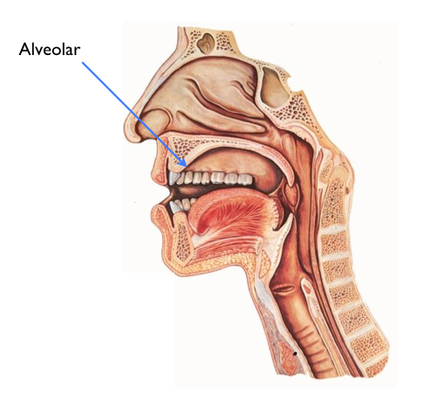
4. Alveolar
(Lidah menyentuh bagian belakang gigi atas)

/n/ as in "no" and "man"
/t/ as in "tab" and "rat"
/d/ as in "dip" and "bad"
/s/ as in "suit" and "bus"
/z/ as in "zit" and "jazz"
/l/ as in "luck" and "fully

 
5. Post-Alveolar
(lidah memblok aliran udara seperti /ʃ/ as in "shoot" or "brash" )

/ʒ/ as in "vision" or "measure"
/tʃ/ as in "chick" or "match" 
/dʒ/ as in "jam" or "badge" 


6. Palatal
(Lidah mnyeentuh langit-langit mulut)

/j/ as in "yes" and "bayou"


 7. Velar
(Lidah belakang menyentuh langit-langit bagian belakang.)

/k/ as in "kite" and "back"
/g/ as in "good" and "bug"
/w/ as in "wet" and "howard"


8. Glottal
(Tidak aktif menggunakan lidah dan bagian mulut lainnya).

/h/ as in "hi" and "Bahamas"


REFERENCE


A Course Book Pronounciation (By:M.Fadly Farhi Abbas, M.Pd)